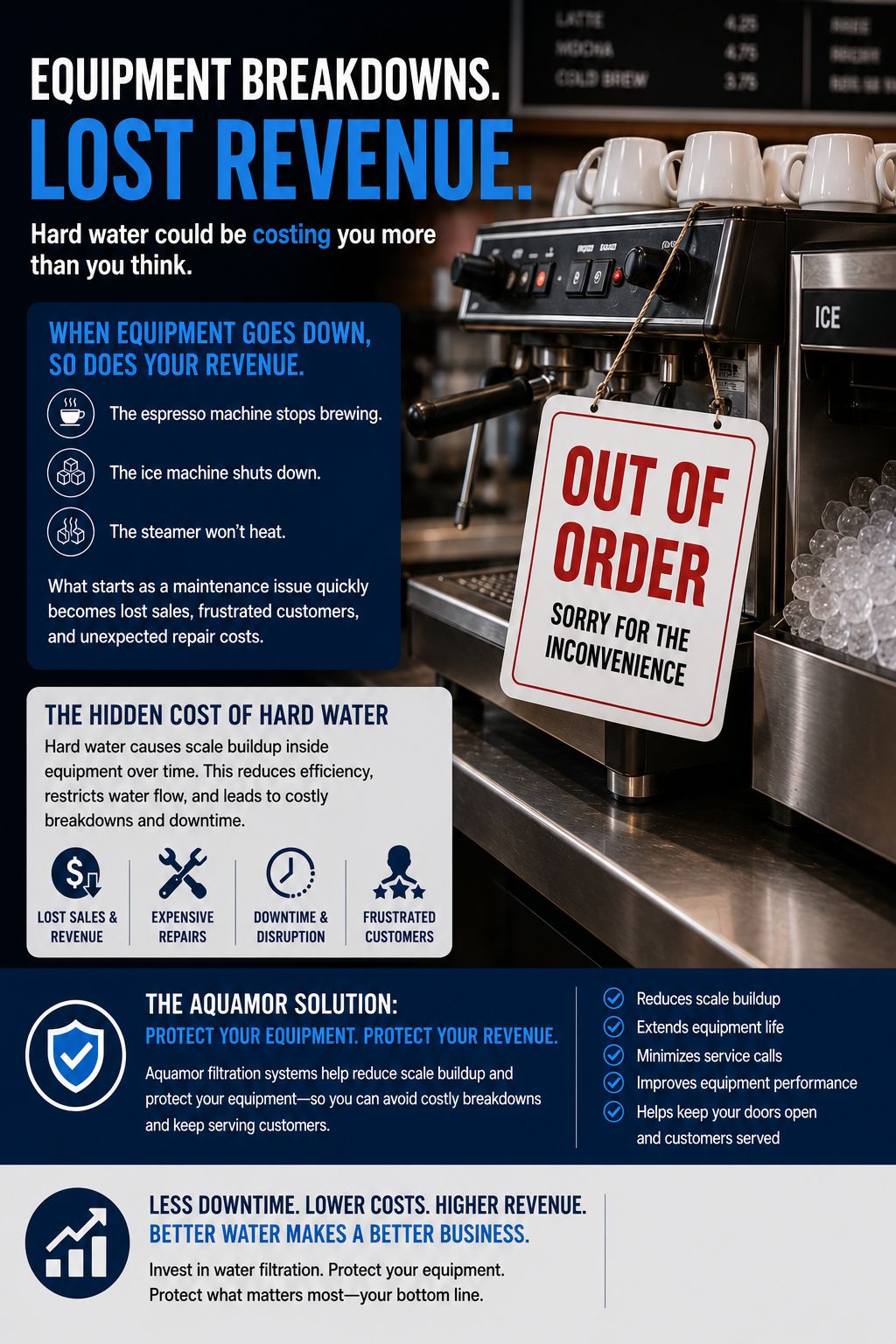
An espresso machine stops brewing during the morning rush.
The ice machine shuts down on a hot afternoon.
A commercial steamer takes longer to heat—or does not heat at all.
What begins as an equipment problem can quickly become something much larger: lost orders, longer wait times, emergency service expenses, frustrated employees, and disappointed customers.
For restaurants, cafés, convenience stores, hotels, and other foodservice businesses, equipment uptime is directly connected to revenue. When water-using equipment goes down, the financial impact is not limited to the repair invoice.
The Real Cost of Equipment Downtime
The true cost of equipment failure can include:
- Sales that cannot be completed
- Products removed from the menu
- Spoiled or unusable inventory
- Emergency service and replacement parts
- Additional employee labor
- Reduced production capacity
- Customers who choose another business
A broken espresso machine may eliminate an entire category of profitable beverages. A failed ice machine can disrupt fountain drinks, food preparation, and customer service. A steamer operating below capacity can slow the kitchen during its busiest hours.
Even when equipment continues running, declining performance can quietly increase operating costs. Longer heating cycles, restricted water flow, inconsistent beverage quality, and repeated maintenance calls may all indicate that a water-related problem is developing.
How Hard Water Contributes to Equipment Failure
Hard water contains elevated amounts of dissolved minerals, particularly calcium and magnesium. According to the U.S. Geological Survey, these naturally occurring minerals are responsible for water hardness.
When hard water is heated or concentrated inside equipment, some of those minerals can form solid calcium carbonate deposits commonly known as scale. The USGS notes that scale can clog pipes, reduce equipment life, increase water-heating costs, and lower equipment efficiency.
That makes hot-water equipment particularly vulnerable, including:
- Espresso machines
- Coffee and tea brewers
- Steamers and proofers
- Hot-water dispensers
- Dishwashing equipment
- Boilers and heat exchangers
Scale can accumulate on heating elements, valves, spray heads, tubing, probes, and other internal components. As the deposits become thicker, equipment must work harder to move water or transfer heat.
The U.S. Department of Energy explains that even thin scale layers can interfere with heat transfer because scale acts as an insulator. In boiler applications, that loss of heat transfer can contribute to reduced efficiency, overheating, and component failure.
Scale Buildup Does Not Always Announce Itself
A complete shutdown may be the most obvious sign of a problem, but scale-related deterioration often begins gradually.
Watch for warning signs such as:
- Longer brewing or heating times
- Reduced water flow
- Smaller or inconsistent ice production
- Unusual equipment noise
- Fluctuating water pressure
- Visible white mineral deposits
- Inconsistent beverage temperature
- More frequent cleaning or descaling
- Repeated valve, pump, or heating-element failures
A machine may still technically operate while producing fewer drinks per hour, using more energy, or requiring additional employee attention. That lost productivity is also a form of revenue loss from equipment failure—even before the machine stops completely.
Protecting Revenue Starts With Understanding Your Water
There is no single water-treatment product that is correct for every operation. The appropriate solution depends on several factors:
- Incoming water hardness
- Alkalinity and total dissolved solids
- Chlorine or chloramine concentration
- Equipment manufacturer requirements
- Peak flow rate
- Daily water consumption
- Available installation space
- Desired contaminant-reduction claims
Espresso machines and steam equipment can require more stringent water conditions than cold beverage dispensers or standard ice-making equipment. Aquamor’s foodservice guidance, for example, lists application-specific operating targets for hardness, alkalinity, pH, total dissolved solids, and other water characteristics.
Testing the incoming water and reviewing the equipment manufacturer’s specifications should therefore come before choosing a treatment system.
How Aquamor Helps Protect Water-Using Equipment
Aquamor Foodservice offers filtration and water-treatment products for restaurants, coffee shops, beverage service, ice machines, steam equipment, and other commercial applications.
Depending on the application and incoming water, an appropriately selected Aquamor system may help:
Reduce scale accumulation
Scale-control and softening products can address the minerals that contribute to deposits inside water-using equipment.
Protect water flow
Reducing sediment and mineral accumulation can help protect small tubing, valves, spray heads, and other flow-sensitive components.
Support heat-transfer efficiency
Cleaner heating surfaces can transfer heat more effectively than surfaces insulated by mineral deposits.
Reduce avoidable service calls
Controlling water-related deposits may reduce the frequency of certain cleaning procedures and scale-related repairs.
Support consistent equipment performance
Properly treated water helps equipment operate closer to its intended flow, temperature, and production capacity.
Improve beverage quality
Filtration can also reduce unwanted chlorine taste and odor, sediment, and other water-quality problems that may affect coffee, tea, ice, and fountain beverages.
The objective is not simply to install a filter. It is to match the treatment method, flow rate, cartridge capacity, and reduction claims to the equipment being protected.
Replacement Schedules Matter
A filtration system cannot provide its intended performance indefinitely without maintenance.
Cartridges should be inspected and replaced according to the applicable product specifications, water conditions, usage volume, and equipment requirements. Waiting until flow drops dramatically or equipment performance changes may mean the cartridge has already remained in service too long.
Operations should document:
- Installation date
- Replacement date
- Metered water volume, where available
- Pressure before and after treatment
- Equipment service history
- Changes in taste, odor, flow, or production
A consistent maintenance schedule makes cartridge replacement predictable and reduces the chance that a neglected filtration system will become another source of downtime.
Turn Equipment Protection Into Revenue Protection
The cost of preventive water treatment should not be compared only with the cost of a repair part.
It should also be compared with the value of every drink, meal, or transaction that depends on the equipment remaining available.
When an espresso machine, ice maker, brewer, or steamer goes down, your business may lose revenue minute by minute. Proper water testing, correctly sized treatment, and routine cartridge replacement can help reduce that risk.
Protecting your equipment is not just about lowering maintenance costs.
It is about protecting capacity, consistency, customer service—and the revenue those systems help generate every day.
Explore Aquamor Foodservice water-treatment solutions or contact Aquamor for help identifying an appropriate system for your equipment and incoming water conditions.
Clean Water. Clear Dedication.